
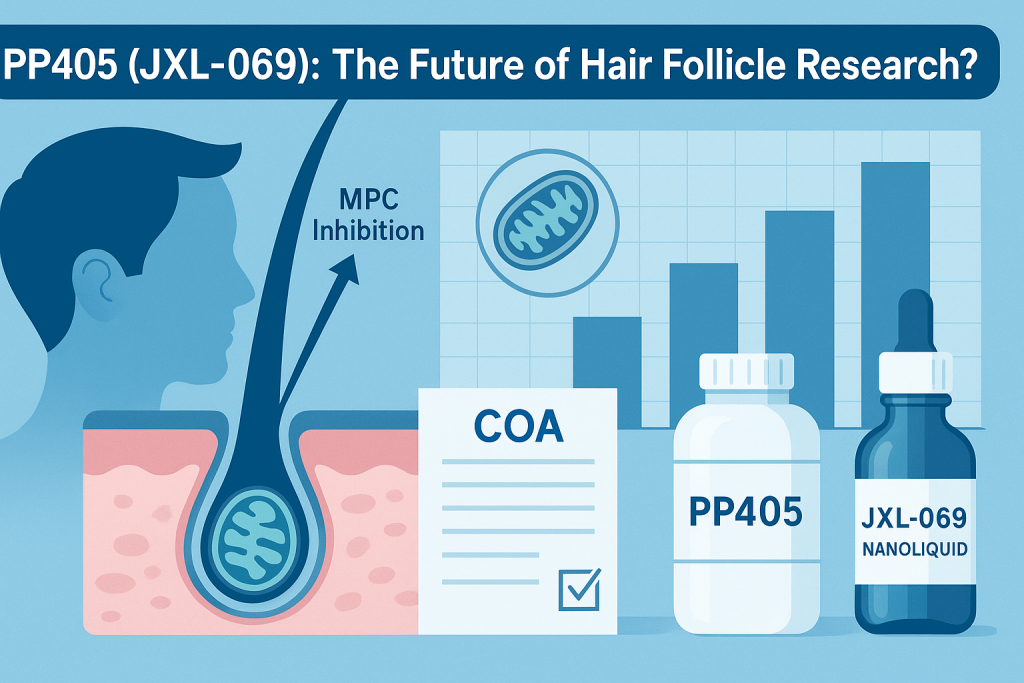
PP405 (JXL-069): The Future of Hair Follicle Research?
Meta Title: PP405 (JXL-069): Momentum in Hair Follicle Research
Meta Description: Why MPC-targeting compounds like PP405 (JXL-069) are drawing serious attention: mechanism, early data, and what labs and communities are seeing.
URL slug: pp405-jxl069-future-of-hair-follicle-research
A year ago, PP405 was mainly conference chatter. Now it’s the molecule many hair-biology researchers have on their short list. The hook is straightforward: rather than modulating androgens, PP405 and related MPC inhibitors aim to re-activate hair-follicle stem cells by shifting metabolism, a line of inquiry with surprisingly deep roots in the literature. That mechanistic clarity—plus early human signals—has nudged PP405 from “interesting” to “worth designing studies around.” PMC+1
For in vitro work, see our JXL-069 (PP405) 0.05% w/v 30mL solution and the overview of what JXL-069 is.
Why the mechanism matters
At the center is the mitochondrial pyruvate carrier (MPC). Inhibiting MPC tilts cells toward glycolysis and lactate production; in mouse and ex vivo human models, that metabolic nudge correlates with bringing quiescent follicle stem cells back online. The foundational work dates to 2017, when researchers showed that promoting lactate production (including via MPC modulation) accelerated follicle-stem-cell activation. Subsequent medicinal-chemistry programs identified potent MPC inhibitors—JXL-069 among them—that advanced the idea beyond theory. PMC+2pubs.acs.org+2
For research teams, this offers a complementary axis to the usual androgen pathway: a stem-cell–centric lever that may combine with existing approaches or open new models altogether.
What the data say right now
Top-line Phase 2a results reported this summer sparked much of the momentum. Trade coverage summarizing Pelage’s readout indicates ~31% of treated participants exceeded a >20% hair-density increase at eight weeks, with no systemic exposure detected and plans to advance to Phase 3 in 2026. These are sponsor-reported figures awaiting full peer-reviewed publication, but they’re concrete enough to shape hypotheses and power calculations for follow-up work. Mainstream and specialty outlets have since highlighted PP405 as a credible entrant rather than a rumor. dermatologytimes.com+2dermatologytimes.com+2
As for JXL-069 vs. PP405: public sources describe JXL-069 as a potent MPC inhibitor in the same chemical family; whether it is identical to the clinical candidate or a related analogue isn’t settled. From a research perspective, treating them as pathway-adjacent (and demanding clear identity documentation) is the careful stance. Wikipedia
Community signal: optimistic, but method-driven
If you scan r/tressless threads, you’ll find two dominant themes. First, optimism—the mechanism resonates, and early numbers give people a reason to watch closely. Second, discipline—the most useful posts share COAs, vehicles, and standardized imaging; the least useful blur compound identity or rely on non-replicable “progress pics.” A recent Week-8 user update, for instance, described only modest visible change, which sparked a practical discussion around vehicle, concentration, and verification rather than blanket conclusions. That kind of peer scrutiny is good news for anyone trying to separate signal from noise. Reddit+1
What this means for labs planning studies
1) Anchor to metabolism. If you’re testing MPC inhibition, log your vehicle recipe (solvents, penetration enhancers, pH) and keep it constant across replicates. In topical work, vehicle and residence time can swing outcomes more than the nominal concentration. PMC
2) Verify the molecule, not the label. Given the JXL-069/PP405 naming tangle, insist on batch-level COAs (HPLC/UPLC, purity %, ideally NMR/HRMS) and clear identifiers that map to references. That’s how you make negative and positive findings meaningful outside your lab. Community experience repeatedly flags mislabeling and variable potency as pitfalls. Wikipedia+1
3) Choose form to fit the question. Powder gives you full control over the vehicle (useful for head-to-head comparisons). Nanoliquid can reduce prep variability in screening phases. Whichever you pick, record assay-corrected dose (purity-adjusted) and solids content for suspensions so your “per mg” math holds up. (Forum sourcing debates often collapse to this point.) Reddit
4) Predefine endpoints. Combine standardized macro/micro imaging with density per cm² and shaft-diameter distributions at fixed timepoints (e.g., baseline, Week 4, Week 8). That’s the language reviewers and collaborators understand.
So—is PP405 “the future”?
It’s too early to crown a champion, but PP405 checks boxes that many failed candidates never did: plausible mechanism, validated target class, and early human signals that justify the attention. If Phase 3 confirms durability and clarifies vehicle parameters, MPC-targeting programs could reshape how follicle studies are designed—either as stand-alone interventions in models of quiescence or as complementary arms alongside androgen-pathway work. That’s a future worth preparing for. dermatologytimes.com
Key Takeaways
- MPC inhibition (and lactate signaling) offers a credible route to re-activate follicle stem cells; JXL-069 figures prominently in the inhibitor literature. PMC+1
- Phase 2a top-line: ~31% crossed a >20% density threshold by eight weeks; Phase 3 is slated for 2026, pending full publications. dermatologytimes.com+1
- Community discussions trend optimistic but method-focused, emphasizing COAs, vehicles, and standardized endpoints over anecdotes. Reddit
- For labs, the near-term win is rigorous study design: verify identity, lock vehicles, and measure objective hair metrics so results travel.