
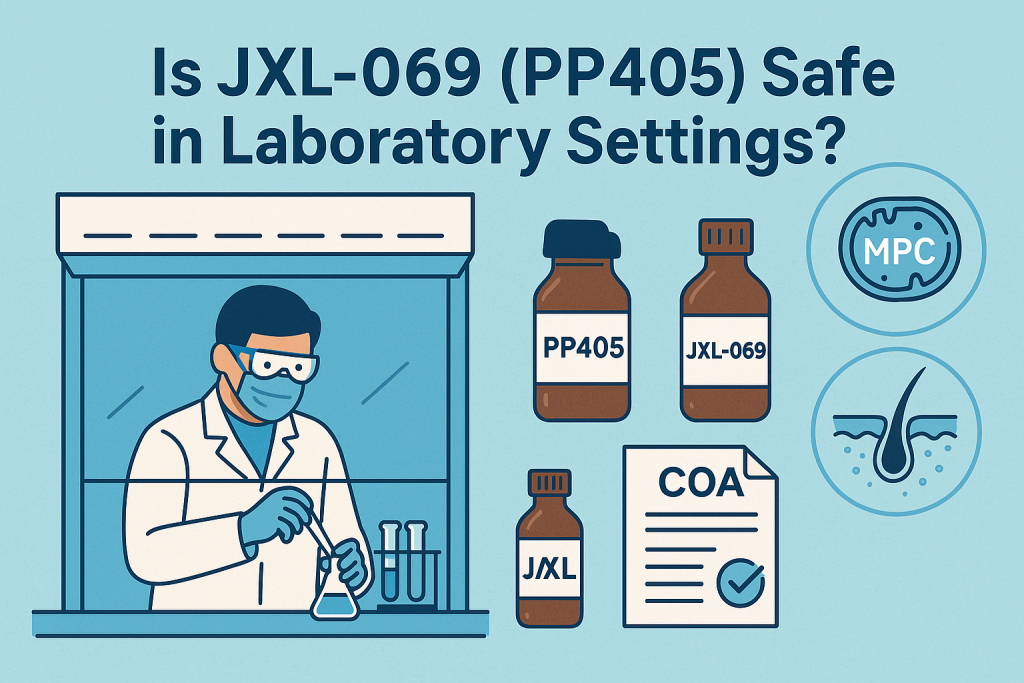
Is JXL-069 (PP405) Safe in Laboratory Settings?
Meta Title: Lab Safety Guide: Working with JXL-069 (PP405)
Meta Description: What researchers should know about safely handling JXL-069 (PP405): mechanism context, early clinical signals, sourcing quality, and practical lab controls.
URL slug: jxl069-pp405-lab-safety-guide
Interest in JXL-069—often discussed alongside PP405—has climbed steadily as metabolic approaches to hair-follicle biology gain traction. That enthusiasm brings a practical question for lab teams: how do we handle this class of compounds safely and sensibly in research environments? Below is a concise, researcher-oriented guide that blends what’s known from the science with what working communities flag in day-to-day practice. Reddit+1
Our JXL-069 research solution and JXL-069 powder are sold for laboratory research only, with a third-party COA.
Why mechanism context matters for safety
JXL-069 appears in the literature as a potent inhibitor of the mitochondrial pyruvate carrier (MPC), the gate that controls pyruvate entry into mitochondria. In hair-follicle models, nudging metabolism toward lactate production has been shown to reactivate follicle stem cells—one reason MPC inhibitors are being explored for androgenetic alopecia. Knowing that you’re working with a bioactive small molecule that modulates cellular metabolism should prompt standard chemical hygiene: minimize exposure, avoid aerosolization, and log concentrations carefully. Wikipedia+2PMC+2
The current efficacy and tolerability picture (briefly)
Early human data around the PP405 program—topical, MPC-focused—reported that about 31% of participants passed a >20% hair-density increase at eight weeks, with plans to advance to Phase 3. Trade coverage also notes good short-term tolerability in controlled settings. These are sponsor-reported, top-line figures pending full publication, but they explain the uptick in lab interest and underscore the need for disciplined handling as more groups try to replicate or extend findings. dermatologytimes.com+1
Sourcing and verification: the first safety control
The most common “safety problem” communities raise isn’t dramatic toxicity—it’s uncertainty about what’s in the bottle. Threads in r/tressless show the spread: reports of mislabeled material, debates over whether a vendor’s “PP405” is authentic, and warnings about sites that change listings or lack documentation. From a safety standpoint, unknown identity and impurities are the biggest risks you can control up front. Require:
- Batch-specific COA (HPLC/UPLC purity, residual solvents; ideally NMR/HRMS).
- Clear identifiers (CAS or internal code that maps to reference data).
- Stability guidance (temperature, light sensitivity, solvent compatibility).
Researchers repeatedly point out that paying for a documented lot saves time, reduces repeat runs, and avoids spurious results that come from mystery stock or unstable vehicles. Reddit+1
Practical lab handling: powder vs. nanoliquid
Powder. Treat as you would other bioactive small molecules: weigh in a ventilated enclosure, avoid open-bench transfers that can create dust, and record assay-corrected mass if purity is <100%. Dissolution should be done with appropriate solvents (record pH, enhancers, and final % w/v). Label intermediate stocks with concentration, solvent, and date. (Community reports emphasize that vehicle choices strongly influence outcomes—good science and good safety often align here.) Wikipedia
Nanoliquid. Pre-formulated suspensions reduce prep variability but come with their own checks: confirm solids content (actual active per mL), shake-test for sedimentation, and store per supplier guidance (amber glass, temperature control). Avoid generating aerosols; dispense using positive-displacement tips or glass syringes in a biosafety cabinet or chemical fume hood, depending on your institution’s policy. Wikipedia
Exposure controls and documentation
- PPE & engineering: Nitrile gloves, lab coat, eye protection; handle stocks in a certified chemical fume hood or ventilated enclosure. Wipe down work surfaces after use with appropriate solvent/neutralizer. (If you use DMSO, remember it enhances skin penetration—treat spills and glove changes accordingly.)
- Labeling & logs: Label every container with compound ID, batch/lot, concentration, solvent, date, and handler initials. Maintain a shared log that links each experiment to a lot number and COA PDF.
- Waste: Segregate solvent waste and aqueous waste per your chemical hygiene plan; never pour residuals into the sink.
- Incident readiness: Stock absorbent pads and spill kits near the hood; practice small-volume spill response (contain, adsorb, seal, label, dispose).
These are routine controls, but they’re the difference between “safe enough” and reproducible science you can stand behind.
Community signal: optimism, with method discipline
If you scan recent discussion threads, you’ll see optimism about MPC modulation paired with method-first advice: standardize imaging and endpoints, pre-register vehicle systems, and verify materials before drawing conclusions. Posts that include COAs, lighting-controlled photos, and concentration details get the most traction; breathless claims without documentation get downvoted or flagged as vendor spam. That crowd-driven norm is a useful safety compass: the more you can verify and standardize, the lower your risk of chasing bad data—or exposing staff to unknowns. Reddit
A note on nomenclature
Is JXL-069 the same as PP405? Public sources hedge: Wikipedia and community analysts suggest they’re related within the MPC-inhibitor family, but not necessarily identical. From a lab-safety perspective, the takeaway is simple—don’t assume equivalence. Match what you buy to the identity on your protocol, and keep the COA in the same folder as your raw data. Wikipedia
Bottom line
In a controlled lab setting, JXL-069/PP405 can be handled safely using standard small-molecule practices plus a few MPC-program specifics: verify identity, treat vehicles as experimental variables, and document everything. Early clinical signals justify the attention; disciplined sourcing and handling keep that attention productive—without preventable hiccups. dermatologytimes.com
Key Takeaways
- MPC-inhibitor context (lactate-driven HFSC activation) explains interest—and calls for standard chemical hygiene. PMC+1
- Top-line PP405 data (≈31% crossing >20% density at eight weeks) increases research demand; full publications are pending. dermatologytimes.com+1
- The biggest safety risk is uncertain identity: insist on batch-level COAs, stability guidance, and clear identifiers. Reddit
- Vehicle and documentation are safety tools: they reduce exposure mistakes and make findings reproducible. Wikipedia