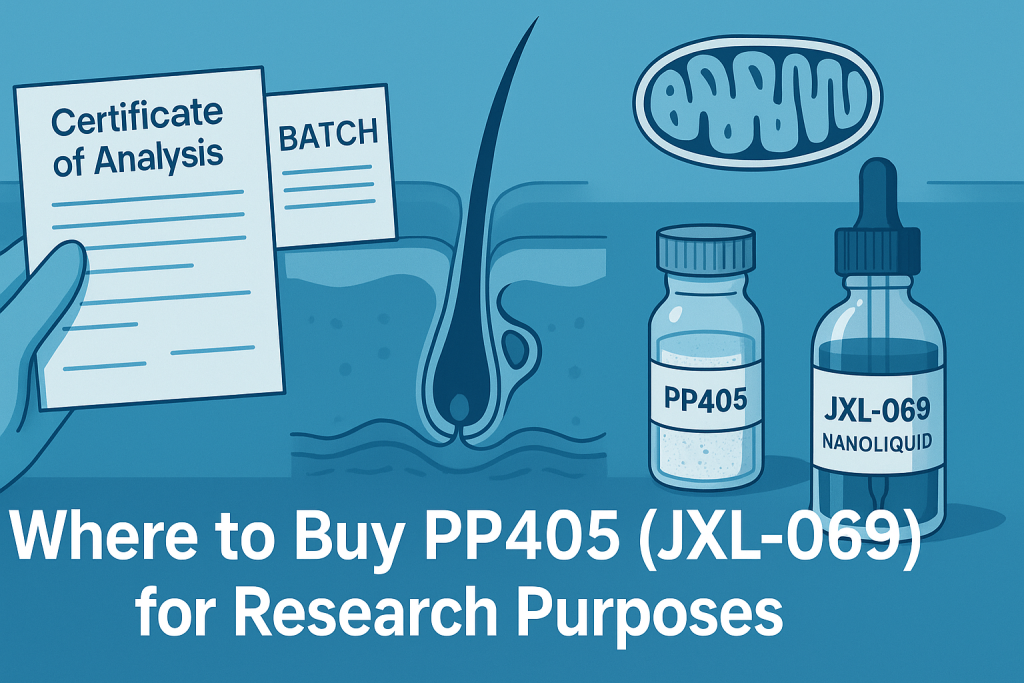

Does PP405 (JXL-069) Really Work? What Research Shows
Meta Title: PP405 (JXL-069): What the Research Shows
Meta Description: Early human signals and a solid metabolic rationale put PP405 (JXL-069) on researchers’ radar. Here’s what studies and communities are seeing now.
URL slug: pp405-jxl069-what-the-research-shows
Over the past year, PP405 has moved from conference chatter to a fixture in hair research roundups. The interest isn’t just hype: a metabolism-first approach—aimed at nudging follicle stem cells back into action—finally has early human signals to sit alongside the preclinical story. For labs mapping next studies, that combination is hard to ignore. dermatologytimes.com
Background: what is JXL-069 and how it compares in JXL-069 vs PP405. JXL-069 is not approved and has no human safety data.
The mechanism—why labs care
PP405 is built around inhibiting the mitochondrial pyruvate carrier (MPC). Shifting how cells process fuel raises lactate, which in turn appears to “wake” follicle stem cells in lab models. This isn’t a hormone-blocking strategy; it’s a metabolic reset that several groups have explored with MPC inhibitors. JXL-069 shows up in that literature and on community threads as a closely related MPC inhibitor, which is why the two names often travel together in discussion. The exact relationship between JXL-069 and the clinical candidate remains a live question, but the pathway overlap explains the shared attention. PR Newswire+1
What the research shows right now
The most concrete update arrived in June 2025: trade press covering Pelage’s Phase 2a reported that about 31% of participants passed a >20% hair-density increase at eight weeks, with the company preparing Phase 3 for 2026. These numbers are top-line and await full peer-reviewed publication, but they’re specific enough to influence how researchers frame follow-on work. dermatologytimes.com+1
The clinical arc traces back to AAD 2024, where Pelage presented late-breaking data on ex vivo activation of human hair-follicle stem cells and Phase 1 findings—essentially, the biological plausibility and early human groundwork that justified moving into controlled efficacy studies. The company’s materials and coverage from that period consistently emphasize MPC inhibition as the lever. PR Newswire+1
Mainstream health media have also started tracking the program, placing PP405 among a new wave of experimental approaches and spotlighting the metabolic rationale for broader audiences—useful context when explaining to stakeholders why labs are exploring non-androgen mechanisms. The Washington Post
Community perspective: cautious optimism, practical hurdles
Research-leaning forums (e.g., r/tressless) are unusually disciplined on PP405. The prevailing mood is positive but careful: members like the mechanism and the early signal, yet they repeatedly warn about sourcing quality, vehicle choice, and protocol drift in informal self-experiments. One widely discussed thread framed PP405 as “promising if the material and vehicle are right,” while others documented mixed visible changes over a few months—more a lesson in methodology than a verdict on the target. In short: the crowd is engaged, but it’s the meticulous posts—COAs, vehicle notes, photo standardization—that other researchers find most useful. Reddit+1
Practical takeaways for lab teams
1) Treat the vehicle as a variable, not an afterthought. For topical work around MPC modulation, penetration and residence time matter. Log solvents, enhancers, viscosity, and pH; lock them before you scale. That discipline will make your results comparable across time and teams. dermatologytimes.com
2) Pre-register endpoints you can defend. Density per cm² and shaft-diameter distributions with standardized imaging beat ad-hoc “progress pics.” A small pilot can bracket concentration and cadence without burning material. [Internal link: Lab FAQs]
3) Verify material identity and stability. Community posts highlight how quickly “JXL-069/PP405” becomes a catch-all label online. If you’re sourcing reference material, insist on documentation so your negative or positive findings aren’t undermined by uncertainty. [Internal link: Product overview] tressless.com
4) Watch the clinical cadence. If Phase 3 begins in 2026 as indicated, expect tighter details on dose, vehicle, and durability. Those disclosures can inform better preclinical alignment and replication studies. dermatologytimes.com
So—does it “work”?
The fair reading is measured optimism. We have a sound mechanism, consistent preclinical rationale, and an early human signal that’s specific enough to plan against. That doesn’t settle durability or responder rates, but it’s materially better than speculation. If the next phase confirms the density gains and clarifies vehicle parameters, PP405 moves from promising to practical for a meaningful subset of cases—and it broadens the research playbook beyond hormone-centric ideas. dermatologytimes.com+1
Key Takeaways
- MPC inhibition offers a credible metabolic route to re-engage follicle stem cells; JXL-069 appears adjacent in the same pathway discussions. PR Newswire+1
- Phase 2a top-line: ~31% crossed a >20% density threshold at eight weeks; Phase 3 is slated for 2026. dermatologytimes.com
- Communities are optimistic but method-focused, stressing vehicle, documentation, and verified material over anecdotes. Reddit+1
- For labs: predefine endpoints, verify inputs, and standardize imaging to make results publishable and comparable. dermatologytimes.com