
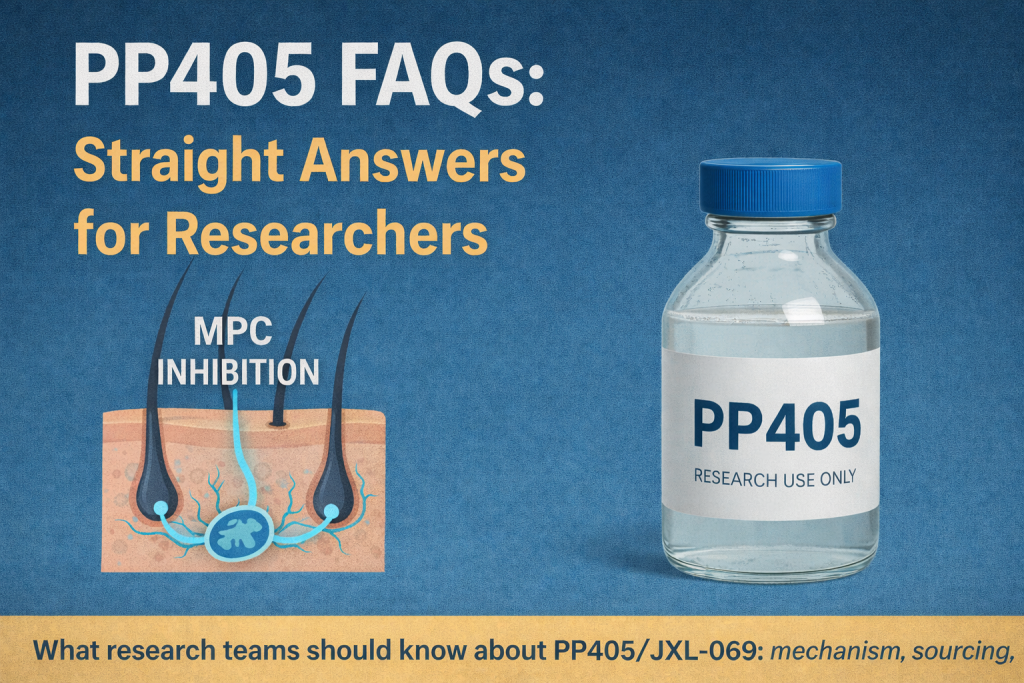
PP405 FAQs: Straight Answers for Researchers
Meta Title: PP405 (JXL-069) FAQs for Researchers
Meta Description: Evidence-led answers about PP405/JXL-069: mechanism, early results, sourcing, vehicles, and study design tips drawn from literature and community practice.
URL slug: pp405-jxl069-faqs-for-researchers
Researchers keep circling back to the same questions about PP405 (often discussed alongside JXL-069). Below is a compact, lab-focused FAQ that blends published findings with what experienced community members actually do in practice.
Quick links: what is JXL-069, JXL-069 vs PP405, JXL-069 results research and buy JXL-069 for laboratory research.
What is PP405, and how does it differ from JXL-069?
PP405 is a topical clinical candidate from Pelage Pharmaceuticals that targets the mitochondrial pyruvate carrier (MPC). JXL-069 appears in the medicinal-chemistry literature as a potent MPC inhibitor in the same family; Pelage has publicly indicated PP405 isn’t identical to JXL-069, though the two share the same metabolic rationale. In other words: treat them as pathway-adjacent, not interchangeable, unless documentation proves identity. Wikipedia+1
What does the current human data look like?
Top-line Phase 2a results reported in June 2025 suggest ~31% of treated participants exceeded a >20% hair-density increase at Week 8 after a short dosing window, with plans to advance to Phase 3 in 2026. Coverage also noted no systemic exposure detected in plasma. Full peer-reviewed data are pending, but the signal explains the surge of bench interest. Dermatology Times+2Dermatology Times+2
Why is MPC inhibition relevant to hair growth research?
Inhibiting MPC shifts pyruvate away from mitochondrial oxidation, nudging cells toward glycolysis and lactate production. Multiple groups have tied increased lactate to activation of hair-follicle stem cells (HFSCs) in preclinical and ex vivo models—hence the excitement around MPC inhibitors as a regenerative lever rather than a hormone-blocking one. PMC+2PubMed+2
Is there any consensus from research communities?
Communities like r/tressless trend optimistic but method-driven. Highly upvoted posts share COAs, vehicle recipes, and standardized imaging; “progress pics” without documentation draw skepticism. Week-8 self-reports often show modest visible change unless vehicle and concentration are carefully controlled—useful reminders about study design, not verdicts on the mechanism. Reddit+1
What documentation should I require before purchasing?
Treat identity verification as Safety + Reproducibility Control #1:
- Batch-specific COA with methods (HPLC/UPLC purity; residual solvents; ideally NMR/HRMS).
- Clear identifiers (CAS or internal code) that map to a reference.
- Stability & storage guidance (temperature, light sensitivity, vehicle compatibility).
Forum sourcing threads repeatedly flag mislabeling and variable potency when these are missing. PubMed+1
Powder or nanoliquid: which format should I start with?
- Powder gives full control of the vehicle (solvents, penetration enhancers, pH) and is ideal for head-to-head vehicle comparisons or dose-finding.
- Nanoliquid can reduce prep variability and improve dispersion in screening phases—just confirm solids content so your mg/mL math is assay-corrected.
In MPC-targeting programs, vehicle and residence time often drive outcomes more than nominal concentration; lock your formula early and keep it stable across replicates. PMC
What endpoints make sense for short windows (e.g., 8 weeks)?
Borrow from public readouts and reviewer expectations:
- Target-area hair count per cm² at baseline, Week 4, Week 8.
- Shaft-diameter distributions to distinguish thickening from mere vellus lengthening.
- Standardized imaging (same device, angle, lighting).
- If you’re exploring combinations (e.g., with AR-pathway agents), build separate arms rather than introducing confounders mid-run.
Pelage’s timepoints (4 weeks dosing, 8 weeks readout) argue for short, disciplined pilots before longer studies. Dermatology Times
Are there safety red flags I should plan around?
Public reports from the PP405 program emphasize no systemic exposure detected in plasma in early trials, alongside favorable short-term tolerability. In the lab, your bigger risks are unknown identity and unstable vehicles—both controllable with sourcing discipline and SOPs. Dermatology Times
How do PP405/JXL-069 compare with androgen-pathway topicals?
They’re orthogonal. AR-antagonist programs (e.g., clascoterone/Breezula, pyrilutamide) aim to reduce DHT signaling over longer windows (often 12–24 weeks), whereas MPC-targeting programs pursue stem-cell re-engagement with earlier readouts. When comparing, align timeframes and metrics or you’ll draw misleading conclusions. Dermatology Times
Practical setup: what do high-signal labs actually do?
From published methods and community practice, a pattern emerges:
- Verify the molecule (COA + identifiers) before it ever touches the hood.
- Pilot small to bracket concentration and cadence; then freeze the vehicle.
- Assay-correct doses by purity and, for suspensions, by true solids content.
- Pre-register endpoints and image standards to prevent measurement drift.
- Archive everything—COAs, chromatograms, prep logs—alongside raw data.
These habits show up repeatedly in credible posts and make your dataset portable across collaborators and reviewers. Reddit
What to watch next
If Phase 3 initiates on the public timeline, expect more granular disclosure on dose, vehicle specifics, and durability—the details that will help preclinical and translational teams refine protocols. Until then, the sensible posture is cautious optimism plus rigorous method. Dermatology Times
Key Takeaways (SEO-friendly)
- PP405/JXL-069 target MPC to increase lactate and activate HFSCs in models—an alternative to androgen-pathway strategies. PMC+1
- Phase 2a top-line: ~31% of participants exceeded >20% hair-density gains by Week 8; Phase 3 planned. Dermatology Times
- Community insights stress COAs, vehicle discipline, standardized imaging; weak results often trace to these variables. Reddit+1
- For hair growth research pilots, pick powder vs. nanoliquid based on study phase and assay-correct doses for clean comparisons. PMC