
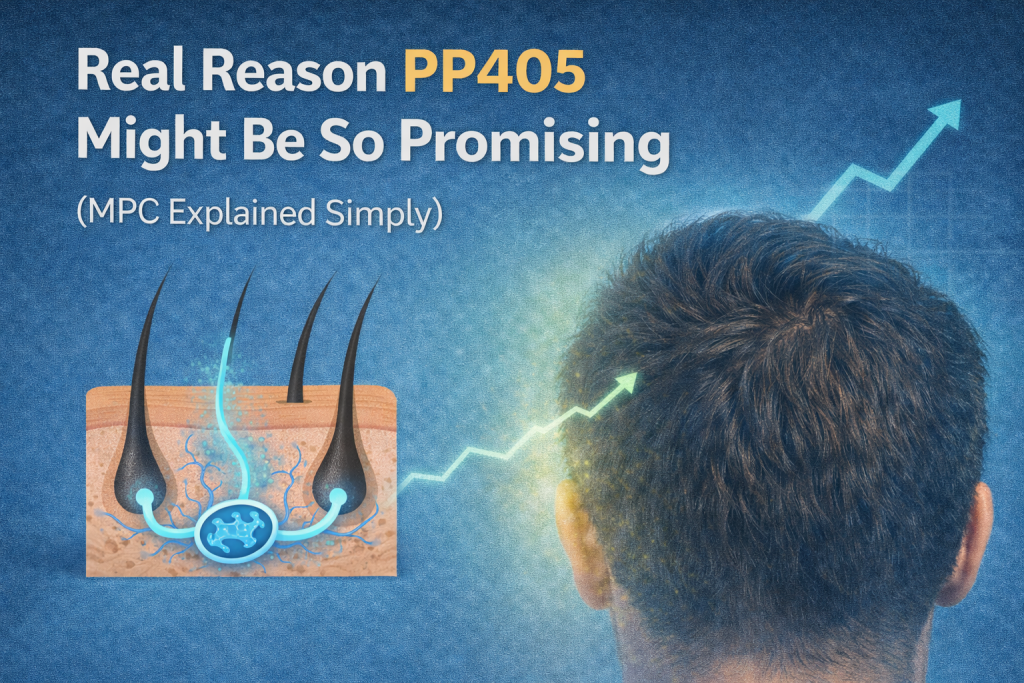
Real Reason PP405 Might Be So Promising (MPC Explained Simply)
Meta Title: Why PP405 (JXL-069) Looks Promising: MPC Explained
Meta Description: A clear, researcher-friendly explainer of how PP405/JXL-069 targets the mitochondrial pyruvate carrier (MPC) to influence hair-follicle stem cells—plus practical lab takeaways.
URL slug: real-reason-pp405-promising-mpc-explained
If you’ve watched PP405 (often discussed alongside JXL-069) move from chemistry slides to conference chatter, you’ve probably heard one phrase more than any other: mitochondrial pyruvate carrier, or MPC. That’s the switch PP405’s class of compounds is designed to modulate. The reason people in hair-growth research keep coming back to it isn’t marketing—it’s that MPC neatly connects cell metabolism to hair-follicle stem cell (HFSC) behavior in a way that’s experimentally tractable.
Want to study MPC inhibition yourself? See our JXL-069 (PP405) research solution and JXL-069 raw powder, for laboratory research only.
Below is a plain-English walkthrough of the mechanism, the signal it creates in models, how communities interpret it, and what lab teams can do with it right now.
1) The one-sentence version of MPC
The MPC is the “gate” that lets pyruvate move from the cell’s cytosol into the mitochondria. When you inhibit that gate, cells lean away from burning pyruvate in the mitochondria and lean toward glycolysis, producing more lactate. That metabolic nudge is small, but in hair-follicle biology it seems to matter: higher lactate is linked to waking up quiescent HFSCs in experimental systems.
Think of it as shifting the energy “mood” of the niche. PP405/JXL-069 don’t add growth factors or block hormones; they tune metabolism so stem cells behave more like they do during active growth phases.
2) Why metabolism, not hormones, is exciting here
Most hair research still revolves around androgen signaling—vital, but only part of the picture. Follicles don’t simply “die” in common hair thinning; they miniaturize and cycle differently. Metabolic reprogramming provides a second lever: rather than pushing against hormones, it aims to re-engage the follicle’s own stem-cell machinery.
Mechanistically, the story is tidy:
- MPC inhibition → more glycolysis → higher lactate.
- Lactate acts as more than a waste product; it influences gene expression and chromatin state, which can promote activation of HFSCs in models.
- Activated HFSCs are associated with thicker shafts and increased local density when the broader follicle environment cooperates.
That elegance—one small change with a wide downstream effect—is exactly what researchers like. It’s also why PP405 shows earlier read windows in some controlled settings (e.g., 4–8 weeks) than you’d expect from pathways that act further downstream.
3) What early signals and communities are actually seeing
Across conference coverage and lab-oriented forums, a consistent pattern emerges:
- Encouraging early signals. Top-line summaries from 2025 highlighted a subset of participants showing meaningful gains in target-area hair counts over a short window. The numbers await full, peer-reviewed unpacking, but they’re strong enough that many teams are planning 2026 pilots around similar timepoints.
- Method over hype. On Reddit’s researcher-heavy threads, the most trusted posts aren’t breathless before/afters—they’re the ones with COAs attached, vehicle recipes documented, and standardized imaging. When results underwhelm, discussions usually trace the issue to vehicle penetration, residence time, or uncertain identity rather than dismissing the mechanism.
- Naming caution. Community analysts repeatedly remind each other that “JXL-069” and “PP405” aren’t guaranteed to be identical. Labs treating them as pathway-adjacent and insisting on batch-specific documentation tend to avoid dead ends.
In short, the optimism exists—but it’s the careful optimism you want around translational science.
4) What this means for study design (practical, lab-facing)
If you’re building or refining a hair growth research protocol around PP405/JXL-069, a few habits pay off:
Verify identity before anything touches the hood.
Ask for batch-level COAs with method detail (HPLC/UPLC purity, residual solvents; NMR/HRMS when available). Map the identifier on your bottle to a reference (CAS or internal code). Without this, neither positive nor negative findings will travel.
Treat the vehicle as a variable, not background.
For MPC-targeting topicals, penetration and residence time are often more influential than nominal dose. Lock your solvent/enhancer/pH recipe, and don’t change it mid-run. If you use a nanoliquid, confirm true solids content so your mg/mL math is assay-corrected.
Build short, disciplined read windows.
Because metabolic nudges can show earlier signals, align imaging at baseline, Week 4, and Week 8. Quantify with target-area hair counts per cm² plus shaft-diameter distributions to separate thickening from vellus changes.
Pilot small, then scale.
Start with a compact screen (e.g., 3–5 replicates per arm) to bracket concentration and cadence. Once a band looks promising, expand with the same SOPs rather than rewriting the vehicle or endpoints.
5) Why PP405 might matter even if it’s not “the one”
Even if a later candidate ultimately outperforms PP405 head-to-head, this program has already helped change the conversation: metabolism is a workable target in hair biology. That opens space for combinations (e.g., orthogonal approaches with androgen-pathway agents) and encourages more mechanistic thinking in protocol design. From a lab’s perspective, that’s progress—because it produces testable hypotheses rather than a new round of guesswork.
Bottom line
The real reason PP405 looks promising is that it ties a well-defined lever—MPC inhibition—to a change that matters for hair biology: HFSC activation. Add encouraging early signals and maturing community standards (COAs, vehicles, standardized endpoints), and you have a research track that’s both plausible and doable. Whether PP405 becomes the flagship or simply the first successful scout, labs that work method-first will be best positioned to learn something useful.
Key Takeaways (SEO-friendly)
- PP405/JXL-069 targets the mitochondrial pyruvate carrier (MPC), shifting metabolism toward lactate that supports hair-follicle stem-cell activation.
- Early readouts point to short-window signals (4–8 weeks) worth testing with objective hair count and shaft-diameter metrics.
- Community best practice: verify with COAs, lock vehicles, confirm solids content in nanoliquids, and standardize imaging.
- Treat JXL-069 vs. PP405 as related but not identical unless documentation proves otherwise.
- For hair growth research, start with small pilots, then scale using the same SOPs to keep findings comparable.