
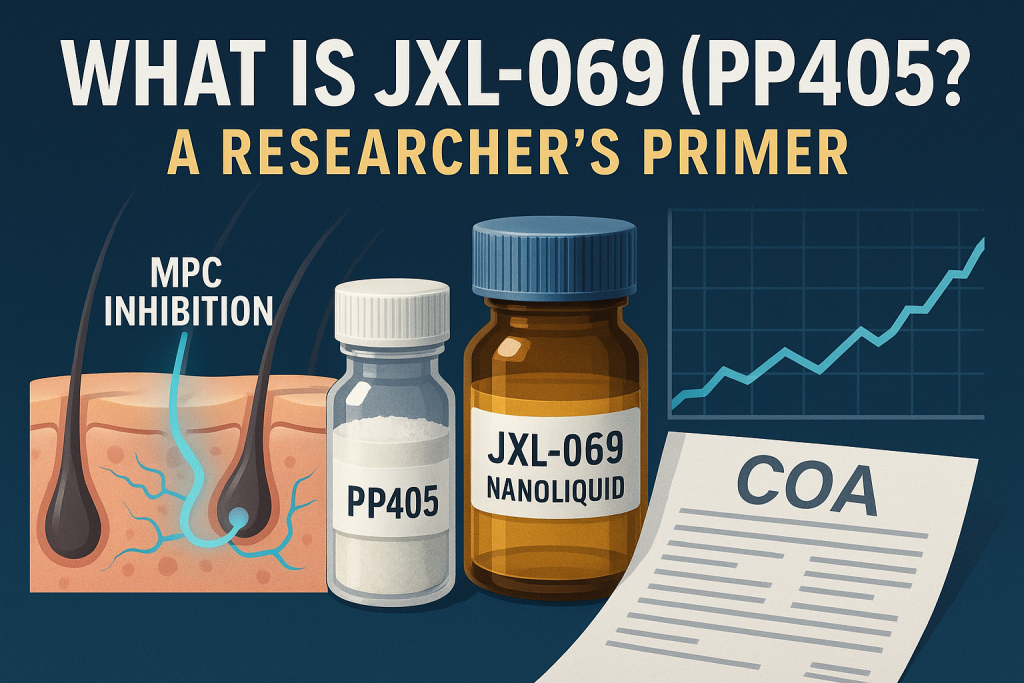
Research use only. JXL-069 is an experimental research compound. It is not approved by any medicines regulator, has never been tested in a human clinical trial and has no human safety data. Nothing on this page is medical advice or a claim that it treats, prevents or reverses hair loss in people.
JXL-069 in one paragraph
JXL-069 (written JXL069 in the original paper) is a small-molecule inhibitor of the mitochondrial pyruvate carrier (MPC). It was designed and synthesised at UCLA by the medicinal chemistry group of Michael Jung, together with the Christofk and Lowry labs, and was first described in the Journal of Medicinal Chemistry in 2021. Researchers often search for it together with PP405, the topical MPC inhibitor that Pelage Pharmaceuticals is taking through clinical trials, because both come from the same UCLA research programme.
Where JXL-069 comes from
The starting point was UK-5099, a long-known MPC inhibitor. In a 2017 mouse study, the UCLA team showed that blocking the MPC in hair follicle stem cells pushed those cells to make more lactate and sped up the switch from the resting phase (telogen) to the growth phase (anagen) of the hair cycle (Flores et al., 2017).
To find better inhibitors, the chemists made a large series of UK-5099 analogues and labelled them JXL001 to JXL088. JXL001 is UK-5099 itself. JXL069 is the analogue with a 7-azaindole core and a 3,5-bis(trifluoromethyl)benzyl group (Liu et al., 2021).
What the published research shows
- In cell assays, JXL069 increased cellular lactate production, a sign of MPC inhibition.
- In permeabilised cells, JXL069 blocked pyruvate-fuelled respiration with an IC50 of about 42.8 nM, compared with about 140 nM for UK-5099. That makes it roughly three times more potent in this assay.
- The 7-azaindole analogue was much more potent than the closely related 4-azaindole and 6-azaindole versions.
- The same paper tested more than ten analogues topically on shaved mice and reported faster hair cycle entry for several of them. The text does not single out JXL069 among the compounds tested in mice.
All of this is cell and mouse research. There are no published human studies of JXL-069.
How JXL-069 works: the MPC mechanism
The MPC is a protein complex in the inner mitochondrial membrane that moves pyruvate into mitochondria. It was identified in 2012 by two independent groups (Bricker et al., 2012; Herzig et al., 2012). When the MPC is blocked, more pyruvate is converted to lactate in the cytoplasm. The UCLA work suggests that this shift towards lactate production is one of the signals that wakes resting hair follicle stem cells in mice. For the full background, see our article on hair follicle stem cells and lactate.
JXL-069, PP405 and the name suvomipic
Pelage Pharmaceuticals licensed the UCLA intellectual property behind PP405 and related topical small molecules, and the three UCLA scientists are Pelage co-founders. Pelage describes PP405 as a topical MPC inhibitor but has not published its chemical structure.
In July 2026, the World Health Organization published the proposed international nonproprietary name (INN) suvomipic for an MPC inhibitor. The chemical name given for suvomipic is identical to the published structure of JXL069. Pelage has not officially linked PP405 to suvomipic or to any disclosed structure, so whether PP405 is the same molecule is not confirmed by an official source. We compare the two in detail in JXL-069 vs PP405.
Current status
- JXL-069 is a research chemical. It is not approved as a medicine anywhere.
- No human safety, dosing or efficacy data exist for JXL-069.
- PP405 is a separate, company-developed product in clinical trials. Its results cannot be transferred to JXL-069 research material. See PP405 explained.
Research applications
JXL-069 is used as a tool compound in laboratory work on MPC inhibition, cellular metabolism, lactate production and hair follicle stem cell biology in cell and animal models. Researchers sourcing it should check identity and purity on a certificate of analysis; our guide explains how to read a JXL-069 COA.
Research-grade material: JXL-069 0.05% w/v 30mL solution or JXL-069 raw powder, both with a third-party COA, for laboratory research use only.
Frequently asked questions
Is JXL-069 approved?
No. JXL-069 is not approved by any regulator and has no human safety data.
Is JXL-069 the same as PP405?
Not officially. Both are MPC inhibitors from the same UCLA research, and the WHO name suvomipic matches JXL069’s structure, but Pelage has not confirmed PP405’s structure.
What does JXL-069 do?
In published cell experiments it inhibits the mitochondrial pyruvate carrier and increases lactate production. Related analogues sped up hair cycle entry in mice.
References
- Liu X, Flores AA, Situ L, et al. Development of Novel Mitochondrial Pyruvate Carrier Inhibitors to Treat Hair Loss. J Med Chem. 2021;64(4):2046-2063. doi:10.1021/acs.jmedchem.0c01570
- Flores A, Schell J, Krall AS, et al. Lactate dehydrogenase activity drives hair follicle stem cell activation. Nat Cell Biol. 2017;19(9):1017-1026. doi:10.1038/ncb3575
- Bricker DK, Taylor EB, Schell JC, et al. A mitochondrial pyruvate carrier required for pyruvate uptake in yeast, Drosophila, and humans. Science. 2012;337(6090):96-100. doi:10.1126/science.1218099
- Herzig S, Raemy E, Montessuit S, et al. Identification and functional expression of the mitochondrial pyruvate carrier. Science. 2012;337(6090):93-96. doi:10.1126/science.1218530
- World Health Organization. International Nonproprietary Names for Pharmaceutical Substances, Proposed INN: List 135 (suvomipic). WHO Drug Information. 2026;40(2). WHO PL135 (PDF)